NEXT-GENERATION BATTERIES
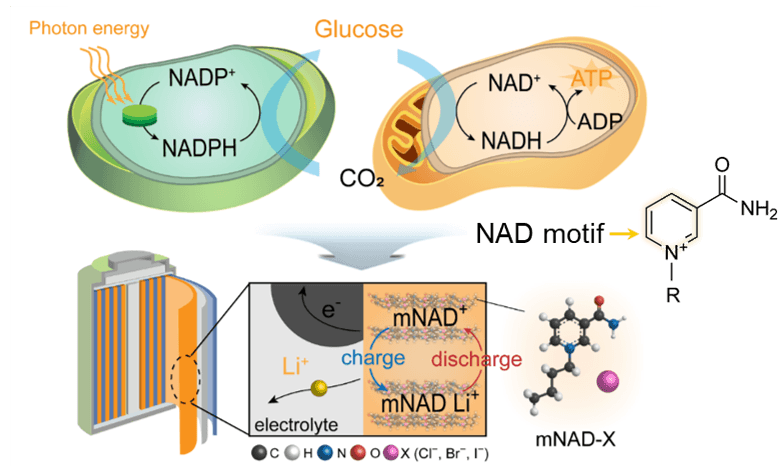


01 ELECTRODE
I turn redox-active organic molecules — including the biological cofactor NAD⁺ — into reversible electrode materials, an alternative to the scarce transition-metal oxides most cathodes rely on.


02 REACTION
Dissolved redox mediators shuttle charge inside the electrolyte and drive the electrode reaction itself — making the oxygen reaction in lithium-air cells reversible enough to cycle.


03 ELECTROLYTE
For lithium-metal anodes, molecular symmetry can control how each Li⁺ ion is solvated — setting how the interphase forms and how stably the cell cycles.
Across all three, I hold every design to the same test. I track it with operando diagnostics — DEMS, EIS, synchrotron X-ray techniques — to confirm the mechanism, not just the result.
RELATED PUBLICATIONS
Angewandte Chemie International Edition 2019, 58, 16764 (Link)
ACS Energy Letters 2021, 6, 1659 (Link)
Bio-inspired electrode designs for secondary batteries
Organic molecule as a reversible redox-active electrode material.
Journal of Materials Chemistry A 2022, 10, 20464–20472 (Link)
Multi-functional redox mediators for ambient-air operational Li-air batteries
Redox mediator controlling the [FILL] reaction in the electrolyte.